In praise of asking, part two
Why should a simple question cost so much? A nine-year-old tested a healing method with a towel and a piece of cardboard, a doctor drank a glass of bacteria, and Socrates drank the hemlock; each price depended on the certainty the question shook.
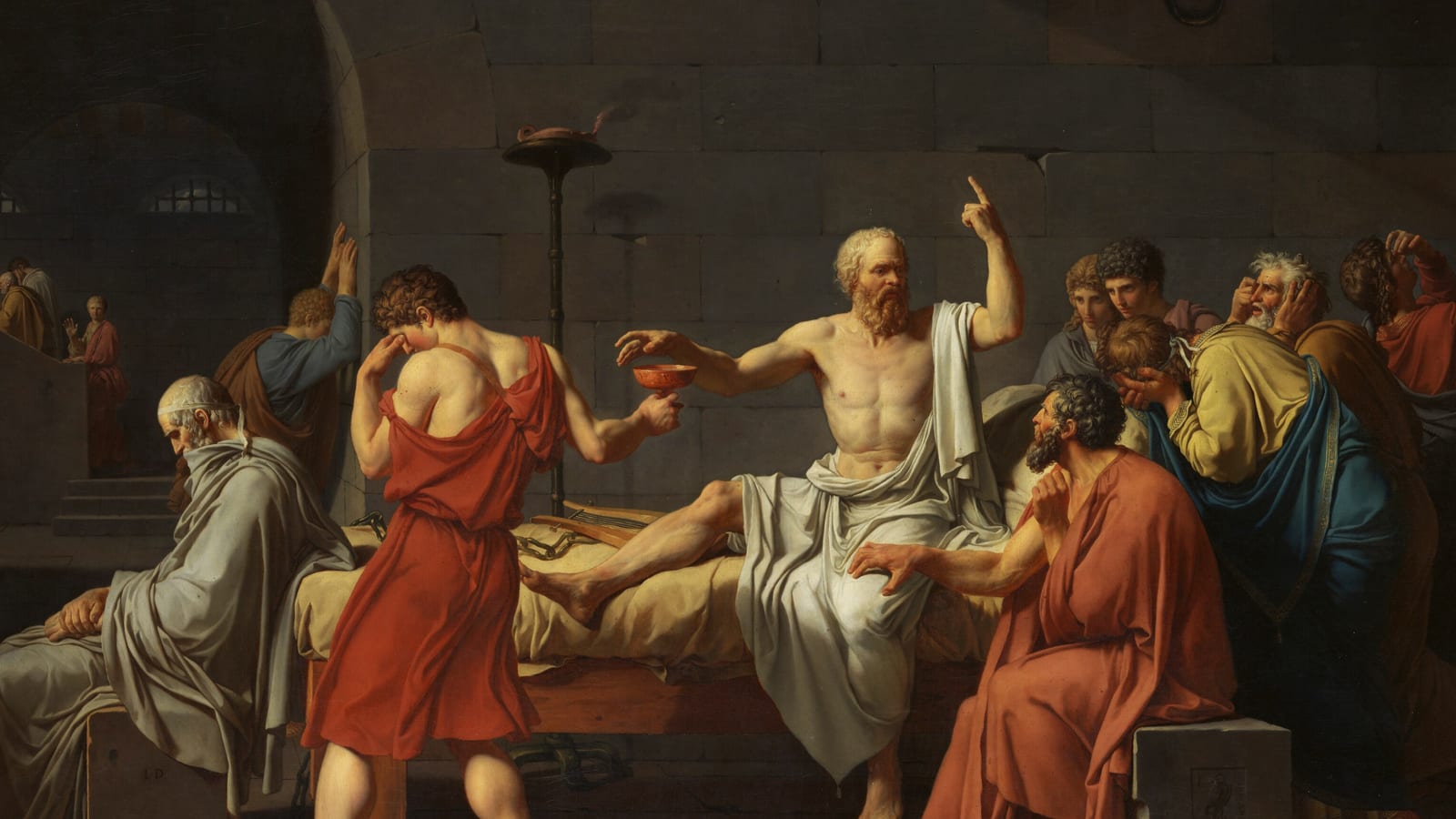
The asking file · Part Two
Perth, Australia, 1984. Barry Marshall, a doctor in his early thirties, has skipped breakfast. At 10 a.m. a colleague hands him a lab beaker about a quarter full of what Marshall called “the cloudy brown liquid”: bacteria scraped off a culture plate, stirred into a kind of meat broth that keeps them alive. Marshall drinks it down in one gulp.
There’s a kind of question you ask to learn, and it only gives away your own ignorance; part one of this file was about that kind. The other kind is more dangerous: the question that gives away someone else’s. Marshall was chasing one of those, and he was paying for it with his own stomach. On the other side of the world, 12 years later, a nine-year-old girl asked one of the same kind, with a towel and a piece of cardboard.
A towel and a piece of cardboard
The United States, 1996. Emily Rosa is nine and needs a project for her fourth-grade science fair. She’s seen a video in which a group of nurses and practitioners talk about a method called “therapeutic touch.” They say the human body has an “energy field,” and that with their hands, without touching the patient, they can feel that field and fix it. The method’s founder has even said anyone can learn to feel it.
Emily had a simple question: can they really feel it? As she put it later, “I wanted to see if they really could feel something.”
The experiment she designed cost almost nothing. She made a screen out of a towel and a piece of cardboard, with two holes at the bottom. The practitioner sat behind the screen and put both hands through the holes, palms up, so they could see neither Emily nor her hand. Emily flipped a coin: heads meant one hand, tails the other. Then she held her own hand 8 to 10 centimeters, about the width of a palm, above that hand and asked: which of your hands is my hand over?
If the energy field existed, this was the easiest test in the world. Someone who says they can sense a patient’s field and heal it should be able to tell which of their own hands has a hand above it.
Take the healer’s seat
The healers got 44% right, less than a coin flip
Tap one of the two hands: which one do you think Emily’s hand is over? Play 20 rounds.
The real experiment’s results
| Practitioners | 21 |
|---|---|
| Trials | 280 |
| Right answers | 123, or 44% |
| Pure guessing | 50% on average |
Over two rounds, in 1996 and 1997, Emily tested 21 practitioners, some with more than 20 years of experience. There were 280 trials in all. The test could have gone against Emily, too: if the practitioners had been right 90 percent of the time, she’d have had to accept that they felt something. A real question also accepts the answer you don’t want. The practitioners got 123 right: 44 percent. Compare that number with this: someone who feels nothing at all and just flips a coin will be right 50 percent of the time on average. The practitioners weren’t better than chance. They were a bit worse!
Emily Rosa’s experiment
The healers were right 44% of the time; pure guessing gets about 50% right
Each press flips a coin 280 times, just like a healer who feels nothing and is only guessing.
The numbers as a table
| Trials in Emily’s test | 280 |
|---|---|
| The healers’ right answers | 123, or 44% |
| Pure guessing, 280 tries, on average | 140, or 50% |
| Chance that pure guessing scores 44% or lower | about 2 in 100 |
In April 1998 the results were published in JAMA, one of the most respected medical journals in the world. Emily was 11, and she later got a Guinness record as the youngest person to have research published in a scientific or medical journal.
Not everyone was happy. The founder of therapeutic touch said, “It’s a cute idea, but it’s not valid.” Critics said the test wasn’t “double-blind,” the sample was small, and the practitioners hadn’t been tested under the real conditions of their work. A few letters of protest reached the journal. But the editor of JAMA replied: “Age doesn’t matter. It’s good science that matters, and this is good science.”
Emily didn’t come out of nowhere, though. Her mother was a nurse, and she and Emily’s stepfather had been critics of this very method for years; they helped her with the test design and the statistics. The question was Emily’s, but she grew up in a house where asking questions wasn’t something to be ashamed of.
The price Emily paid was small: not being taken seriously. In her words, “I think they didn’t take me very seriously because I’m a kid.” The English philosopher Miranda Fricker has a name for this: testimonial injustice. It’s when we believe someone less, just because of who they are. So the price of a question also depends on who’s asking. And some questions cost a lot more.
A glass of brown broth
Perth, Australia, June 11, 1979. Robin Warren, a pathologist at Royal Perth Hospital, is looking at a sample from a patient’s stomach under the microscope and sees something that shouldn’t be there: small spiral bacteria, stuck to the stomach lining. That day was his 42nd birthday.
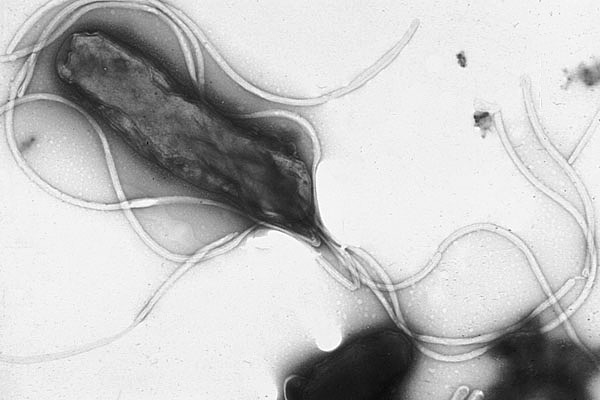
Two years later Barry Marshall, who had come to the gastroenterology unit for a training rotation, joined Warren. Their question was simple and close to heresy: could these bacteria be what causes stomach ulcers?
Back then, everyone “knew” where ulcers came from: stress, bad food, smoking, alcohol, and genes. Marshall said later that, to everyone else, a bacterial cause was “preposterous,” and that medicine’s understanding of ulcers was “akin to a religion.”
For months they tried to grow the bacteria in the lab and failed. Over Easter 1982, because of the holiday, the culture plates sat in the incubator from Thursday to Tuesday, much longer than usual. On Tuesday they saw small, clear colonies on the plates. The bacteria just needed more time.
The first culture, Easter 1982
Nothing at 48 hours; the colonies only show up days later
The usual check. The plate is empty, so normally it goes in the bin.
The timeline as a table
| Thursday morning, April 8 (hour 0) | Plates go into the incubator |
|---|---|
| Saturday (hour 48) | The usual check; an empty plate was thrown out |
| Tuesday morning, April 13 (hour 120) | Small, clear colonies: the first culture |
| A first culture usually needs | four to seven days |
The medical world, though, needed more time too. In 1983 they sent a summary of their research to the Gastroenterological Society of Australia’s conference, and it was rejected. In January 1984 Marshall tried to infect four piglets with the bacteria to prove they caused disease. It didn’t take in any of them.
And here, in mid-1984, Marshall reached for that glass of brown liquid, something people still argue about. He hadn’t told the ethics committee, or his wife. He told his wife that night, on the logic that it would be “easier to get forgiveness than permission.”
For the first three days nothing happened. From day five to day eight he woke before dawn and vomited. His wife complained that his breath smelled bad. On day 10 they did an endoscopy: his stomach was full of the same spiral bacteria, and inflamed. By day 14 his body had cleared the bacteria on its own; after that he took antibiotics anyway, to be sure.
Marshall’s experiment on himself, 1984
Sick by day five, clear of the bacteria by day 14
Day 10: Endoscopy: the stomach was inflamed and full of the spiral bacteria.
The days as a table
| Day | What happened |
|---|---|
| 0 | Before breakfast, he drank down a glass of the bacterial culture. |
| 1 to 3 | Nothing happened. |
| 5 to 8 | He woke before dawn and vomited; his breath smelled bad. |
| 10 | Endoscopy: the stomach was inflamed and full of the spiral bacteria. |
| 14 | His body had cleared the bacteria on its own; he took antibiotics to be sure. |
This one-man experiment didn’t prove the bacteria cause ulcers; it only showed they can inflame a healthy stomach. Full proof took years of further research. But the question could no longer be ignored. Marshall later wrote that his results were disputed and disbelieved, “not on the basis of science but because they simply could not be true.”
The philosopher of science Thomas Kuhn had already described this situation in 1962. In Kuhn’s view, science mostly works inside an established framework, which he called a “paradigm,” and at first ignores whatever doesn’t fit, until the day it no longer can. Not everyone takes such a bleak view, of course. Paul Thagard, a philosopher who studied this case closely, argues that for an idea this strange, waiting about 10 years for the evidence to pile up wasn’t all that unreasonable.
In 1994 the US National Institutes of Health recommended that ulcers caused by this bacterium be treated with antibiotics. And in 2005 Warren and Marshall won the Nobel Prize in Medicine, “for their discovery of the bacterium Helicobacter pylori and its role in gastritis and peptic ulcer disease.” A disease people used to live with for years is now cured with a short course of drugs.
Helicobacter pylori, 1979 to 2005
The discovery took five years; being believed took ten more
The years of not being seen, 1983 to 1994
The dates as a table
| When | What |
|---|---|
| June 11, 1979 | Warren sees the spiral bacteria |
| 1981 | Marshall joins Warren |
| Easter 1982 | The first culture grows |
| 1983 | Their abstract is rejected |
| January 1984 | The piglets don’t get infected |
| Mid-1984 | Marshall drinks the culture |
| 1994 | NIH: treat with antibiotics |
| 2005 | Nobel Prize |
The price Marshall paid was his own body, and years of not being seen. Now put these two side by side. Emily just wasn’t taken seriously; Marshall put his body on the line. Both questions were simple. So why were the prices so different? And how dangerous does a question have to be before its price is a person’s life?
The man who asked the most
Athens, late 5th century BC. One day a friend of Socrates named Chaerephon goes to the temple at Delphi and asks the oracle: is anyone wiser than Socrates? The answer: no.
When Socrates heard this, he was puzzled. As Plato tells it, he asked himself what the god could mean, since he knew he wasn’t wise. So he decided to find someone wiser than himself, to work out what the answer meant. He went first to the politicians, then the poets, then the craftsmen. He questioned each of them about the things they claimed to know. And each time he reached the same conclusion: they think they know things they don’t. The craftsmen did know their trade, but because they knew it, they thought they also knew about the most important things. The only difference between Socrates and them was that he didn’t have that illusion. He said this work earned him many enmities, “such as are most harsh and grievous.”
He saw himself as a gadfly stuck to a big, well-bred but sluggish horse, a horse called Athens. His job was to sting it and keep it awake.
In 399 BC three men brought charges against him. The bitter part is that each one stood for one of the very groups Socrates had grilled: Meletus for the poets, Anytus for the craftsmen and the politicians, and Lycon for the orators. The charges: corrupting the young, and not believing in the city’s gods.
The jury had about 500 members. Socrates made his defense, the votes were counted, and he was convicted. He said himself that if only 30 votes had gone the other way, he would have been acquitted: about one juror in 17.
The trial of Socrates, 399 BC
500 jurors, and a margin of 30 votes
280 to convict, 220 to acquit: guilty. Socrates said that if only 30 votes had gone the other way, he would have been acquitted. Move the slider.
The votes as a table
| Jurors | about 500 |
|---|---|
| To convict (reconstructed) | 280 |
| To acquit (reconstructed) | 220 |
| If 30 votes had switched | 250 to 250, a tie, so acquittal |
In Athens, the convicted man could propose his own penalty. Socrates first proposed that the city give him free meals, the honor they gave Olympic champions. His reasoning: an Olympic champion makes you look happy, but I make you happy. There was another way out, too: exile, and keeping quiet. He refused, and this is where he said the most famous line of his trial: the unexamined life is not worth living. So he counted the price of not asking as higher than the price of death. Then, at his friends’ urging, he proposed a fine, which Plato and a few others guaranteed. The court sentenced him to death anyway.
Historians still argue about why Athens did it. A few years earlier the city had come through a short, bloody dictatorship, and some of its leaders had been in Socrates’ circle. There was an older fear, too: 24 years before, in his play The Clouds, Aristophanes had shown Socrates as a man who uses clever questions to hollow out young people’s beliefs and puts nothing in their place. The German philosopher Hannah Arendt wrote in the 20th century that this fear isn’t baseless: thinking really does loosen established rules, and that’s why it’s dangerous. To some, Socrates was a gadfly that wakes you up; to others, an electric ray, the comparison Meno, one of his partners in another of Plato’s dialogues, had made: a fish that numbs anyone who touches it. Athens had made up its mind. All it had to wait for was a ship.
The cup
The execution was put off for 30 days, because until a sacred ship that sailed to the island of Delos each year came back, executions were forbidden. For those 30 days his friends visited him in prison every day.
On the last day, as Plato tells it in the Phaedo, Socrates talked with his friends about death and the soul until close to sunset, with the same questions as ever. Then the prison servant came and told him he was the noblest and gentlest man who had ever come to that prison, and then burst into tears. Crito, his old friend, said the sun was still on the mountains; there was no hurry. Socrates refused.
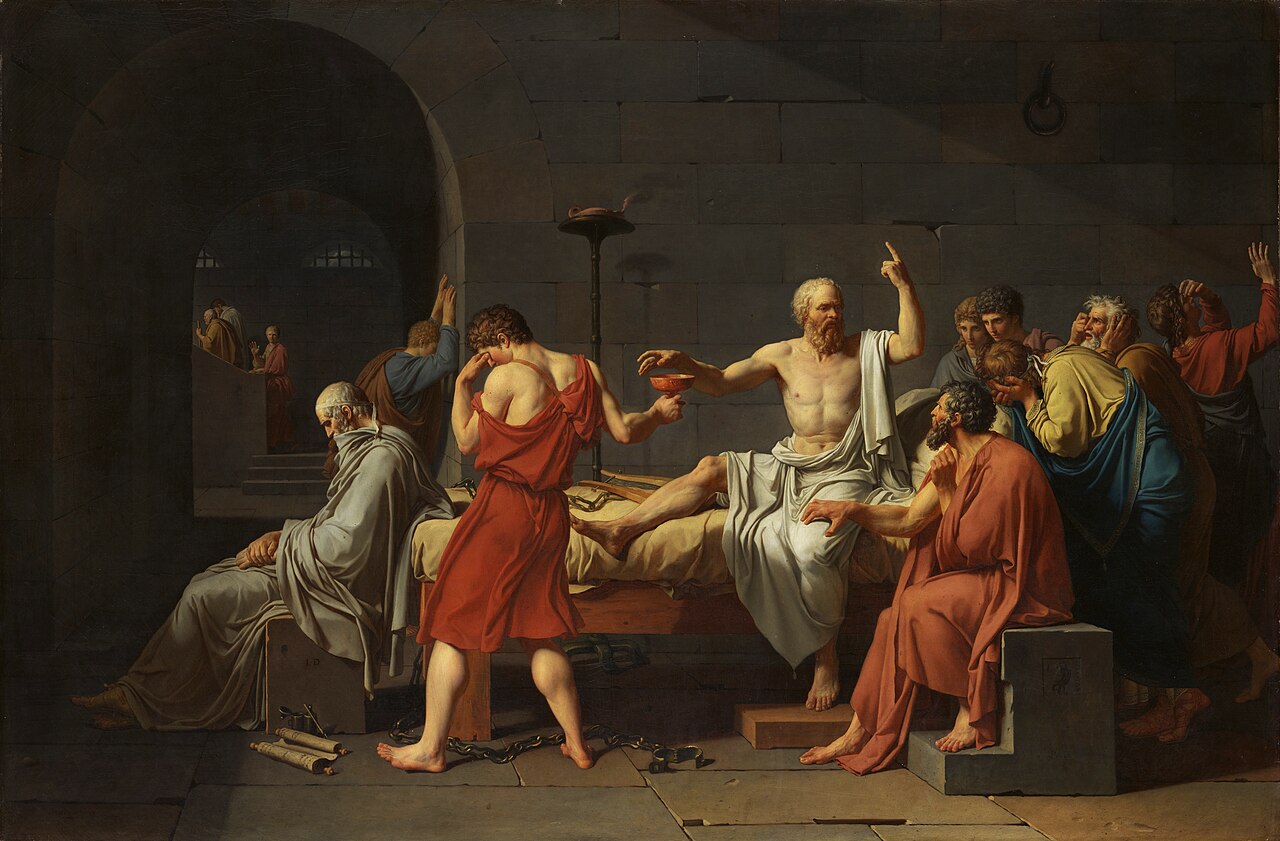
They brought the cup. Plato never names the poison; “hemlock” was added by later sources. Socrates took the cup and, before drinking, asked one more question: may I pour a little of this on the ground as an offering to the gods?
The man who had brought the cup answered that they had prepared only as much as was needed.
He drank it calmly and without fuss. His friends, who had held back their tears until then, couldn’t anymore. Socrates told them to be quiet and strong. He walked until his legs grew heavy, then lay down. The cold slowly climbed up from his feet.
The price of a question
All three questions were simple. The difference was the certainty each one shook: that of a few practitioners, of all of medicine, of a whole city. Each time the asker paid the price alone, and the answer went to everyone; a stomach ulcer is now cured with a short course of drugs.
When the chill reached his groin, Socrates uncovered his face and said his last words: “Crito, we owe a cock to Aesculapius. Pay it and do not neglect it.” Aesculapius was the god of healing.
Further reading
 The Last Days of SocratesPlato, translated by Hugh Tredennick and Harold Tarrant (Penguin Classics)
The Euthyphro, Apology, Crito and Phaedo in one paperback: the trial, the prison and the death of Socrates, told by his student.
 The Trial of SocratesI. F. Stone, 1988
A journalist who learned ancient Greek after retiring, so he could see Socrates’ trial through his accusers’ eyes too.
- Barry Marshall’s Nobel lectureBarry Marshall, 2005
The whole story in Marshall’s own words, from the Easter plates to that glass. Free.
Sources and notes
- Emily Rosa’s experiment: Rosa L, Rosa E, Sarner L, Barrett S, “A Close Look at Therapeutic Touch,” JAMA 279(13), April 1, 1998, pp. 1005–1010. PubMed; details of the test from the full text.
- Emily’s quotes and the reactions: TIME, “Emily’s Little Experiment”; and Wikipedia: Emily Rosa. The Guinness record (1999) is for a “scientific or medical journal.”
- Critiques of the test: a roundup of the critiques; and Cox, Alternative Therapies in Health and Medicine 9(1), 2003 (PubMed).
- The Marshall and Warren story, and the glass: Barry Marshall, Nobel lecture, 2005; Marshall’s Nobel biography; Warren’s Nobel biography.
- The 48-hour check and the Easter plates: Marshall, Nobel lecture, pp. 256–257: plates with nothing on them at 48 hours were thrown out; that Easter they stayed in the incubator from Thursday, April 8, to Tuesday, April 13.
- How long a first culture takes: Martín Alonso Bayona Rojas, “Microbiological conditions for culturing Helicobacter pylori,” Revista Colombiana de Gastroenterología 28(2), 2013 (SciELO). Colonies usually appear after four to seven days.
- The rejected 1983 abstract: Revista Española de Enfermedades Digestivas, 2006.
- The papers: Lancet, June 4, 1983 (PubMed); Lancet, June 16, 1984 (PubMed); the self-experiment: Medical Journal of Australia 142, 1985.
- The 1994 recommendation: NIH Consensus Conference (PubMed).
- The 2005 Nobel Prize: nobelprize.org.
- The Delphic oracle and the questioning: Plato, Apology, 20e to 23b. Perseus.
- The accusers and the charges: Apology, 23e to 24c.
- The most important things: Apology, 22c–e.
- The gadfly: Apology, 30e.
- Exile, silence and the unexamined life: Apology, 37c to 38a. The line was spoken after the verdict, while proposing a penalty.
- Testimonial injustice: Miranda Fricker, Epistemic Injustice (Oxford University Press, 2007).
- Paradigm: Thomas Kuhn, The Structure of Scientific Revolutions (1962), chapters 6 to 8.
- Another view of the Marshall case: Paul Thagard, “Ulcers and Bacteria I & II,” Studies in History and Philosophy of Biological and Biomedical Sciences 29, 1998; and How Scientists Explain Disease (Princeton, 1999).
- 30 votes, free meals and the fine: Apology, 36a to 38b. The exact vote count (for example 280 to 220) is a historians’ reconstruction, not Plato’s own number.
- Political background: Stanford Encyclopedia of Philosophy: Socrates; Aeschines, Against Timarchus 1.173 (Perseus).
- The Clouds: Aristophanes, Clouds, 423 BC.
- Thinking is dangerous: Hannah Arendt, The Life of the Mind, vol. 1, “What Makes Us Think? The Answer of Socrates” (1978).
- The electric ray: Plato, Meno, 80a; W. R. M. Lamb’s translation calls it “the flat torpedo sea-fish.” Perseus.
- The 30-day wait: Plato, Phaedo, 58a to 58c; Xenophon, Memorabilia 4.8.2.
- The last day, the cup and the last words: Plato, Phaedo, 116b to 118a. Perseus.
- Translation quoted: Plato, Apology and Phaedo, translated by Harold North Fowler, in Plato in Twelve Volumes, vol. 1 (Harvard University Press / William Heinemann, 1966), on Perseus.